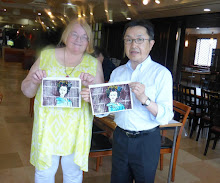
Above: My tuk-tuk driver
I just realised I should've put this photo in my previous post - he was my tuk-tuk driver in Kanchanaburi on the morning of my last day, but .... ah well, he's here now and so here he'll stay!
The road back to Bangkok
After being driven back to my guesthouse, I waited around a bit near reception for the driver of the mini-bus that was to take me back to Bangkok. For some reason, I didn't take a photo on that journey. I'm not sure why, but I do remember we stopped along the way while the driver filled the tank up with petrol, and we had a bit of time (not much) to go to the loo, grab a coffee, have a smoke or get a bite to eat.
Only I spoke with the driver, apart from three Thai passengers (the driver was Thai) and I remember thinking why don't any of the other passengers (read farfangs) speak with him too. They were a miserable lot - I've seen more life in a corpse compared to that lot of passengers!
Hua Lamphong Station
The driver dropped me off in Bangkok and said I'd need to get a taxi to the station as he didn't go there. Caught a taxi - 65 baht - and arrived at Hua Lamphong Station. It was pretty hot but not unpleasant. Spent the time taking photos and learning my way around the station.
Left Luggage
After asking a few people, I found the place where you can store your luggage - as you go through the entrance, turn right, walk along and it's right down the end. There's a staffed luggage office which is open from around 4am until 11pm daily. Price was 100 baht for the suitcase and 50 baht for the small hold-all. You get given a ticket with a number - hang on to your ticket, you won't be able to collect your luggage without it.
Above: Hua Lumphong Station
The concourse inside Bangkok Hua Lamphong Station is massive and when I say massive, I mean m.a.s.s.i.v.e - it's huuuuge. So many people, here, there and everywhere. People sitting on seats, people in groups, people talking, laughing, waiting. There was so much life and movement here.
Above: Wall murals
Up high on the walls above the sides are these fantastic murals - a kaleidoscope of colours and pictures. Some very talented artists indeed. And so beautifully executed. A mish-mash, a meandering mixture of marvellous, melodramatic images.
Above: King Rama V
The King's picture hangs above the entrance to the platforms and every day at 8.00am and 6.00pm, the national anthem is played and everyone stands to attention. I knew of this before I went to Thailand and so I, too, stood still at 6pm.
A bit of trivia
King Rama V (reigned 1868-1910) - layed the foundation of the modern Thai state, and is known as the father of Thai railways because he expanded the rail network nationwide.
Above: Leafy garden and greenery
There are plants and lots of greenery near each of the platforms - what a brilliant idea. They look quite charming amid the modern steel of technology and give the place a relaxing air.
Above: Platform 9¾
As soon as I stood here, I felt the urge to walk up to a railway staffer and ask (in an English accent), "Excuse me, can you tell me where Platform 9 and 3 quarters is please?" !
Yes, I saw Harry Potter and that scene always sticks in my memory when he asks that same question and the railway porter answers, "Platform 9 and 3 quarters? Think you're being funny do yer?"
Above: Pink Taxis
I bought Chinese noodles for 25 baht - noticed the bowl was half full yet Thai people got a full bowl. Met a lady called Carol and we struck up a conversation. It was the accent you see - you can tell an Aussie a mile away. She was from Sydney and we had coffee. I had iced coffee (65 baht) and very welcome it was too.
Outside, there are many taxis in all colours of the rainbow - ever seen a pink taxi? No? Well neither had I until I came to Bangkok. What the blokes would say back home I've no idea, but I get a smile on my face thinking of your true Aussie bloke getting into a pink taxi!
Above: Entrance to Hua Lamphong Station
Finding my way outside and navigating the ever present traffic, I stood across the road and admired the station building. Hua Lamphong Station built in the Italian Neo-Renaissance style, was designed by Italian architect Mario Tamagno and opened on 25th June, 1916.
Hua Lamphong has fourteen platforms, twenty-six ticket windows, two electric display boards. More than 130 trains and over 60,000 passengers use this station each day.
Above: Water fountain
This water fountain stands in front of the station and I'm sure it's most impressive when the water is going at full blast.
Above: Traffic Jam
If you thought Melbourne or Sydney had traffic jams - think again. Bangkok is filled with vehicle of all descriptions and the roads were packed.
Above: Staghorn Fern
Many of the trees have ferns growing on them which makes for a pleasing picture.
Above: Weird Hairdos
On my way back to the station, I noticed these hair styles.
Above: Goody Num-Nums
There are many food shops at the station - this is one of them. Don't they look scrumdiddlyumptios? I put on half a kilo just looking at them!
Thailand Time
Click On Your Flag To Translate
Thailand and Laos (and Myanmar if I can manage it)
Hello, Sawatdee kaa and Sabai dee,
My next trip will be Thailand and Laos, and this is all about the before, the trip and the after - similar to my Malaysia/Cambodia blog. I am putting together from start to finish - tickets, do's and don'ts, tours, where to stay, places to see, things to do, as well as useful extras like transport, good places to eat, what to wear, climate, tourist traps, tricks and tips and whatever else I can think of that will be useful.
If you have any tips or advice, please, feel free to leave a comment and add your bit - whatever you think may be helpful or interesting.
Cheers.
My next trip will be Thailand and Laos, and this is all about the before, the trip and the after - similar to my Malaysia/Cambodia blog. I am putting together from start to finish - tickets, do's and don'ts, tours, where to stay, places to see, things to do, as well as useful extras like transport, good places to eat, what to wear, climate, tourist traps, tricks and tips and whatever else I can think of that will be useful.
If you have any tips or advice, please, feel free to leave a comment and add your bit - whatever you think may be helpful or interesting.
Cheers.
Thailand map
View Bangkok Thailand in a larger map
Playlist - My Travel Videos
Sunday, August 28, 2011
Thursday, August 11, 2011
60. Kanchanaburi War Cemetery
DON RAK CEMETERY
About
This cemetery, the largest of three on the Burma-Siam railway, is located near the site of the former "Kanburi" Prisoner of War Base Camp through which most prisoners passed on their way to other camps. The cemetery, designed by Colin St Clair Oakes, was created after the war by the Army Graves Service who transferred graves into it from camp burial grounds and solitary sites all along the southern half of the railway and from other sites in Thailand.
More than 5,000 Australian and British and 1,800 Dutch casualties are commemorated in the cemetery, including some 300 men who died of sickness at Nieke and Changaraya and who were cremated. Their ashes are buried in two graves in the cemetery and their names appear on panels in the shelter building. The names of eleven soldiers of the Indian army whose graves elsewhere in Thailand could not be maintained are commemorated by name on a tablet in the entrance building.
Poignant and Emotive
As I got out of the tuk-tuk, I saw a plain building entrance with three arches and beyond was a sea of green. There are many plaques on the entrance walls, each filled with words that stir the heart strings. It was a sobering moment as I stood there, reading quietly. All these soldiers, these men, died in a foreign land while serving their country so we could be free.
As I passed through the entrance, I beheld green - green as far as the eye could see with small grave markers in neat rows. Row upon row upon row. The beautiful manicured lawn is kept like a jewel from the water of many sprinklers; the graves are lovingly tended by the Thai people. Here, the weeds do not grow, the flowers on each grave are proudly looking to the sun as the men whose graves they are on were denied in their camps. Here too, is a peacefulness that is visible, a place of serene calm and an aura of acceptance.
An old timber cart sits under a tall, shady tree to the right, the water sprinkles in a gentle arch and one hears the hiss, hiss, hiss as it falls, people walk respectfully among the rows of graves, local people in wide-brimmed hats to protect from the fierce sun kneel and remove weeds, and all around, all I can see are the graves. So many graves. As I look ahead, I see the huge Memorial Cross, standing like a beacon of light. I am drawn to this Cross, it is as if an invisible hand is steering me to it, and as I walk slowly, oh so slowly, the tears come. My tears fall for what this place is and what it represents. And I cried - I cried for the thousands and thousands of men who died - men who would never see their children grow, would never hear the sound of birds singing, men who gave the greatest gift a man can give - their life.
I cried for the waste of so many human lives what was it for? What is war ever for and about? Here in this quiet place, take time to reflect on the tragedy of war, for the suffering and futility which in the end, solves nothing. For there will always be an end and when that end comes we have to ask why?
Above: Entrance
The cemetery is on Saeng Chuto Road, opposite the Railway Station, about 1 km from Kanchanaburi city. The cemetery is maintained by the Commonwealth War Graves Commission.
Above: Lest We Forget
Above: Commemorating the Indian forces
Above: Gift of the Thai people
Above: Inscription in three languages
The inscription reads in English, Thai and Dutch:
"After entering the Second World War in December 1941, the Japanese forces quickly overran most of South East Asia. In 1942, in order to find a shorter and more secure line of supply between Burma and Siam (now Thailand), the Japanese decided to use prisoners of war and civilian labour to build a single line railway to link existing railheads at Thanbyuzayat in the west and Ban Pong in the east. Two forces, one based in Siam and one in Burma, worked from opposite ends of the line, meeting at Konkuita in October 1943. The project cost the lives of approximately 15,000 prisoners of war and 100,000 civilians as a result of sickness, malnutrition, exhaustion and mistreatment.
This cemetery, the largest of three on the Burma-Siam railway, is located near the site of the former "Kanburi" Prisoner of War Base Camp through which most prisoners passed on their way to other camps. The cemetery, designed by Colin St Clair Oakes, was created after the war by the Army Graves Service who transferred graves into it from camp burial grounds and solitary sites all along the southern half of the railway and from other sites in Thailand.
More than 5,000 Commonwealth and 1,800 Dutch casualties are commemorated in the cemetery, including some 300 men who died of sickness at Nieke and Changaraya and who were cremated. Their ashes are buried in two graves in the cemetery and their names appear on panels in the shelter building. The names of eleven soldiers of the Indian army whose graves elsewhere in Thailand could not be maintained are commemorated by name on a tablet in the entrance building.
The Commonwealth War Graves Commission is responsible for the maintenance of graves and memorials in some 150 countries which commemorate around 1,700,000 members of the Commonwealth forces who died in the two world wars. Those commemorated here and elsewhere include servicemen and women of several different faiths and of none."
Above: Cemetery Register
Above: Worker at the cemetery
+
ROWS AND ROWS OF GRAVES
Above: Maintaining the graves
Above: A time to remember. Requisite in pace
Above: Requisite in pace - Young men who died far too early
Above: One grave - one story. Requisite in pace
Above: Walking toward the Memorial
Above: Memorial Cross
Above: Wreaths around the Cross
Above: Looking back to the entrance
Above: 1942 - 1945
Tribute to Royal Dutch Army and Navy Personnel.
One thing that stands out is the age - so many were so young.
+
The tragedy of war is that it uses man's best to do man's worst
About
This cemetery, the largest of three on the Burma-Siam railway, is located near the site of the former "Kanburi" Prisoner of War Base Camp through which most prisoners passed on their way to other camps. The cemetery, designed by Colin St Clair Oakes, was created after the war by the Army Graves Service who transferred graves into it from camp burial grounds and solitary sites all along the southern half of the railway and from other sites in Thailand.
More than 5,000 Australian and British and 1,800 Dutch casualties are commemorated in the cemetery, including some 300 men who died of sickness at Nieke and Changaraya and who were cremated. Their ashes are buried in two graves in the cemetery and their names appear on panels in the shelter building. The names of eleven soldiers of the Indian army whose graves elsewhere in Thailand could not be maintained are commemorated by name on a tablet in the entrance building.
Poignant and Emotive
As I got out of the tuk-tuk, I saw a plain building entrance with three arches and beyond was a sea of green. There are many plaques on the entrance walls, each filled with words that stir the heart strings. It was a sobering moment as I stood there, reading quietly. All these soldiers, these men, died in a foreign land while serving their country so we could be free.
As I passed through the entrance, I beheld green - green as far as the eye could see with small grave markers in neat rows. Row upon row upon row. The beautiful manicured lawn is kept like a jewel from the water of many sprinklers; the graves are lovingly tended by the Thai people. Here, the weeds do not grow, the flowers on each grave are proudly looking to the sun as the men whose graves they are on were denied in their camps. Here too, is a peacefulness that is visible, a place of serene calm and an aura of acceptance.
An old timber cart sits under a tall, shady tree to the right, the water sprinkles in a gentle arch and one hears the hiss, hiss, hiss as it falls, people walk respectfully among the rows of graves, local people in wide-brimmed hats to protect from the fierce sun kneel and remove weeds, and all around, all I can see are the graves. So many graves. As I look ahead, I see the huge Memorial Cross, standing like a beacon of light. I am drawn to this Cross, it is as if an invisible hand is steering me to it, and as I walk slowly, oh so slowly, the tears come. My tears fall for what this place is and what it represents. And I cried - I cried for the thousands and thousands of men who died - men who would never see their children grow, would never hear the sound of birds singing, men who gave the greatest gift a man can give - their life.
I cried for the waste of so many human lives what was it for? What is war ever for and about? Here in this quiet place, take time to reflect on the tragedy of war, for the suffering and futility which in the end, solves nothing. For there will always be an end and when that end comes we have to ask why?
Above: Entrance
The cemetery is on Saeng Chuto Road, opposite the Railway Station, about 1 km from Kanchanaburi city. The cemetery is maintained by the Commonwealth War Graves Commission.
Above: Lest We Forget
Above: Commemorating the Indian forces
Above: Gift of the Thai people
Above: Inscription in three languages
The inscription reads in English, Thai and Dutch:
"After entering the Second World War in December 1941, the Japanese forces quickly overran most of South East Asia. In 1942, in order to find a shorter and more secure line of supply between Burma and Siam (now Thailand), the Japanese decided to use prisoners of war and civilian labour to build a single line railway to link existing railheads at Thanbyuzayat in the west and Ban Pong in the east. Two forces, one based in Siam and one in Burma, worked from opposite ends of the line, meeting at Konkuita in October 1943. The project cost the lives of approximately 15,000 prisoners of war and 100,000 civilians as a result of sickness, malnutrition, exhaustion and mistreatment.
This cemetery, the largest of three on the Burma-Siam railway, is located near the site of the former "Kanburi" Prisoner of War Base Camp through which most prisoners passed on their way to other camps. The cemetery, designed by Colin St Clair Oakes, was created after the war by the Army Graves Service who transferred graves into it from camp burial grounds and solitary sites all along the southern half of the railway and from other sites in Thailand.
More than 5,000 Commonwealth and 1,800 Dutch casualties are commemorated in the cemetery, including some 300 men who died of sickness at Nieke and Changaraya and who were cremated. Their ashes are buried in two graves in the cemetery and their names appear on panels in the shelter building. The names of eleven soldiers of the Indian army whose graves elsewhere in Thailand could not be maintained are commemorated by name on a tablet in the entrance building.
The Commonwealth War Graves Commission is responsible for the maintenance of graves and memorials in some 150 countries which commemorate around 1,700,000 members of the Commonwealth forces who died in the two world wars. Those commemorated here and elsewhere include servicemen and women of several different faiths and of none."
Above: Cemetery Register
Above: Worker at the cemetery
ROWS AND ROWS OF GRAVES
Above: Maintaining the graves
Above: A time to remember. Requisite in pace
Above: Requisite in pace - Young men who died far too early
Above: One grave - one story. Requisite in pace
Above: Walking toward the Memorial
Above: Memorial Cross
Above: Wreaths around the Cross
Above: Looking back to the entrance
Above: 1942 - 1945
Tribute to Royal Dutch Army and Navy Personnel.
Tuesday, August 9, 2011
59. JEATH War Museum
The Death War Museum (Wat Tai)
History
This museum was initiated by Phra Dharma Khunaphon, the abbot of Wat Tai, in 1977, as another reminder of appalling effects of wars. The museum replicates the thatched detention hut with cramped bamboo bunks of POW's during the Second World War. It contains not only weapons, tools and utensils of WWII, but also paintings, photos and articles reflecting the lives of these POW's during the construction of the Death Railway.
The museum is on the bank of the River, inside Wat Chai Chumphon temple. The present Chief Abbot, the Venerable Phra Theppanyasuthee, takes responsibility for the upkeep of the museum.
Above: JEATH War Museum
The word "JEATH" stands for the names of the six countries involved - Japan, England, Australia, America, Thailand and Holland. The Japanese were the controllers of the railway project, Thailand was involved as the conquered country and the other four countries were involved as POW's on the actual construction of the 415 km long Death Railway and the bridge over the River Kwae. The word JEATH also replaces the word Death because it sounds too horrific.
Above: Front entrance of the JEATH war museum, Kanchanaburi, Thailand
Above: JEATH Museum Building
The first thing you see is this bamboo hut with a collection of photographs. The hut is very similar to those used as living quarters of the POW's while they were forced by the Japanese army to construct the Death Railway linking Thailand and Burma.
The hut is not an original but has been built as a copy of an original and inside you can see how the prisoners lived.
Above: Section of the museum narrating the construction of the Death Railway
This part recreates the quarters of the POW's
Above: Military exhibit at the JEATH war museum
The sign in front reads, "By the time World War II, the prisoners of war were forced to build a strategic bridge across the River Kwae to Burma by the Imperial Japanese Army, but at the same time the Allied airforce led by the USA were trying to bomb the bridge to stop them. This bomb was dropped to destroy the River Kwae bridge in 1945, but it didn't explode because it had gone down in the river."
Original photos of the POW's
Below are photos I took - there are a number of them and I had considered making a collage of them but due to the nature of the subject, felt to give them the respect they required they needed to be shown individually.
Above: Malnourished POW's
Above: The Latrines
Above: POW's conveying water to the camp and hospital
Above: Washing clothes without soap
Above: Lining up for rations before working - rice with little salt.
Above: Grinding rice
Grinding rice - "pap" - soft, mushy boiled rice.
Above: Sleeping space for each POW is 2.5 feet in width
Above: The POW camp made of bamboo and attap roof
An attap roof is made from tree leaves.
Weapons
Above: Weaponry
Situated about 500 metres from the TAT office in the area of Wat Chai Chumphon. The bamboo hut has been constructed in the form of a POW camp and contains photographic, pictorial and physical memorabilia dating from WWII.
Above: Map of Thai - Burma Railway
Above: Bomb Bell leading to the river
History
This museum was initiated by Phra Dharma Khunaphon, the abbot of Wat Tai, in 1977, as another reminder of appalling effects of wars. The museum replicates the thatched detention hut with cramped bamboo bunks of POW's during the Second World War. It contains not only weapons, tools and utensils of WWII, but also paintings, photos and articles reflecting the lives of these POW's during the construction of the Death Railway.
The museum is on the bank of the River, inside Wat Chai Chumphon temple. The present Chief Abbot, the Venerable Phra Theppanyasuthee, takes responsibility for the upkeep of the museum.
Above: JEATH War Museum
The word "JEATH" stands for the names of the six countries involved - Japan, England, Australia, America, Thailand and Holland. The Japanese were the controllers of the railway project, Thailand was involved as the conquered country and the other four countries were involved as POW's on the actual construction of the 415 km long Death Railway and the bridge over the River Kwae. The word JEATH also replaces the word Death because it sounds too horrific.
Above: Front entrance of the JEATH war museum, Kanchanaburi, Thailand
Above: JEATH Museum Building
The first thing you see is this bamboo hut with a collection of photographs. The hut is very similar to those used as living quarters of the POW's while they were forced by the Japanese army to construct the Death Railway linking Thailand and Burma.
The hut is not an original but has been built as a copy of an original and inside you can see how the prisoners lived.
Above: Section of the museum narrating the construction of the Death Railway
This part recreates the quarters of the POW's
Above: Military exhibit at the JEATH war museum
The sign in front reads, "By the time World War II, the prisoners of war were forced to build a strategic bridge across the River Kwae to Burma by the Imperial Japanese Army, but at the same time the Allied airforce led by the USA were trying to bomb the bridge to stop them. This bomb was dropped to destroy the River Kwae bridge in 1945, but it didn't explode because it had gone down in the river."
Original photos of the POW's
Below are photos I took - there are a number of them and I had considered making a collage of them but due to the nature of the subject, felt to give them the respect they required they needed to be shown individually.
Above: Malnourished POW's
Above: The Latrines
Above: POW's conveying water to the camp and hospital
Above: Washing clothes without soap
Above: Lining up for rations before working - rice with little salt.
Above: Grinding rice
Grinding rice - "pap" - soft, mushy boiled rice.
Above: Sleeping space for each POW is 2.5 feet in width
Above: The POW camp made of bamboo and attap roof
An attap roof is made from tree leaves.
Weapons
Above: Weaponry
Situated about 500 metres from the TAT office in the area of Wat Chai Chumphon. The bamboo hut has been constructed in the form of a POW camp and contains photographic, pictorial and physical memorabilia dating from WWII.
Above: Map of Thai - Burma Railway
Above: Bomb Bell leading to the river
Subscribe to:
Posts (Atom)